Werewolves

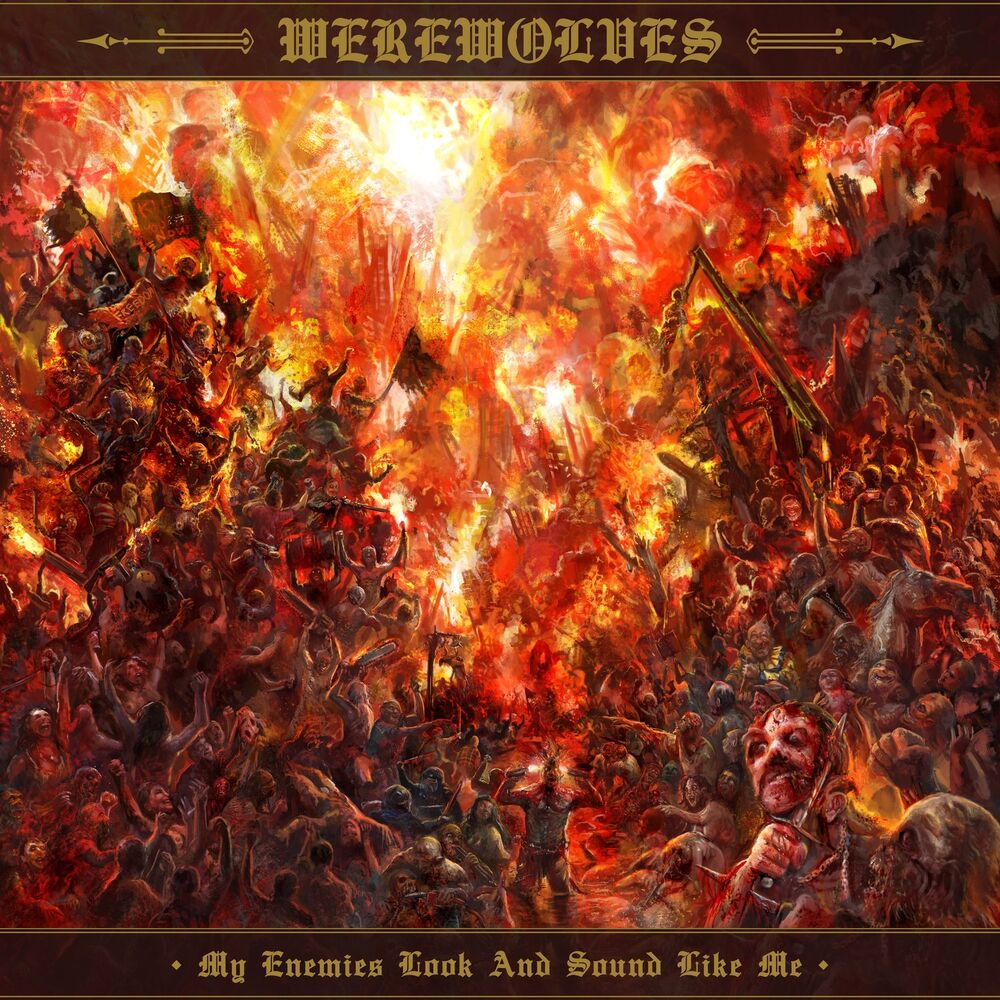
Werewolves
۴۲۱ طرفدار
جدیدترینها

Uroboric Fuckwit
Tank Habit
You're Weak & You Know You're Weak
Fields Of Suicide
Triple Negative
آخرین انتشارها

You're Weak And You Know You're Weak
آخرین انتشار • آلبوم
You're Weak & You Know You're Weak
۲۰۲۶ • تکآهنگ
Fields Of Suicide
۲۰۲۶ • تکآهنگ
Triple Negative
۲۰۲۶ • تکآهنگ


طرفداران اینها را هم گوش میدهند


درباره
۴۲۱ طرفدار
۳۷ انتشار • فعال از ۲۰۰۸
In folklore, a werewolf (from Old English werwulf 'man-wolf'), or occasionally lycanthrope (from Ancient Greek λυκάνθρωπος 'wolf-human'), is an individual who can shapeshift into a wolf or therianthropic hybrid wolf–humanlike creature, either voluntarily or involuntarily due to a curse or other affliction. In modern fiction, especially film, transformations are often depicted as triggered by the full moon and transmitted by a bite or scratch from another werewolf. Early sources for belief in this ability or affliction, called lycanthropy, are Petronius (27–66) and Gervase of Tilbury (1150–1228). The werewolf is a widespread concept in European folklore, existing in many variants, which are related by a common development of a Christian interpretation of underlying European folklore developed during the Middle Ages. From the early modern period, werewolf beliefs spread to the Western Hemisphere with colonialism. Belief in werewolves developed in parallel with the belief in witches during the late Middle Ages and the early modern period. Like the witchcraft trials as a whole, the trial of supposed werewolves emerged in what is now Switzerland, especially the Valais and Vaud, in the early 15th century and spread throughout Europe in the 16th, peaking in the 17th and subsiding by the 18th century. The persecution of werewolves and the associated folklore is an integral part of the "witch-hunt" phenomenon, albeit a marginal one, with accusations of lycanthropy being involved in only a small fraction of witchcraft trials. During the early period, accusations of lycanthropy (transformation into a wolf) were mixed with accusations of wolf-riding or wolf-charming. The case of Peter Stumpp (1589) led to a significant peak in both interest in and persecution of supposed werewolves, primarily in French-speaking and German-speaking Europe.
ادامهی بیوگرافی
In folklore, a werewolf (from Old English werwulf 'man-wolf'), or occasionally lycanthrope (from Ancient Greek λυκάνθρωπος 'wolf-human'), is an individual who can shapeshift into a wolf or therianthropic hybrid wolf–humanlike creature, either voluntarily or involuntarily due to a curse or other affliction. In modern fiction, especially film, transformations are often depicted as triggered by the full moon and transmitted by a bite or scratch from another werewolf. Early sources for belief in this ability or affliction, called lycanthropy, are Petronius (27–66) and Gervase of Tilbury (1150–1228). The werewolf is a widespread concept in European folklore, existing in many variants, which are related by a common development of a Christian interpretation of underlying European folklore developed during the Middle Ages. From the early modern period, werewolf beliefs spread to the Western Hemisphere with colonialism. Belief in werewolves developed in parallel with the belief in witches during the late Middle Ages and the early modern period. Like the witchcraft trials as a whole, the trial of supposed werewolves emerged in what is now Switzerland, especially the Valais and Vaud, in the early 15th century and spread throughout Europe in the 16th, peaking in the 17th and subsiding by the 18th century. The persecution of werewolves and the associated folklore is an integral part of the "witch-hunt" phenomenon, albeit a marginal one, with accusations of lycanthropy being involved in only a small fraction of witchcraft trials. During the early period, accusations of lycanthropy (transformation into a wolf) were mixed with accusations of wolf-riding or wolf-charming. The case of Peter Stumpp (1589) led to a significant peak in both interest in and persecution of supposed werewolves, primarily in French-speaking and German-speaking Europe.
منبع: ویکیپدیا